
Meige syndrome is a cranial dystonia in which involuntary spasms of the eyelids (blepharospasm) occur together with dystonia of the lower face, jaw, mouth or tongue (oromandibular dystonia). Patients blink excessively or cannot keep their eyes open, and the jaw clenches or pulls open, the mouth grimaces and the tongue pushes forward. Speaking, eating and reading can become very difficult. It is also called orofacial or cranial dystonia.
Botulinum toxin injections help many patients, especially for the eyelids, but jaw and tongue muscles are harder to inject. For disabling Meige syndrome, deep brain stimulation works well: in a randomized, double-blind multicenter trial of 62 patients, movement scores improved by about 60% after 12 months with either the pallidal (GPi) or subthalamic (STN) target.[1]
Meige syndrome or orofacial dystonia: which name is right?
Both are used, and they overlap:
- Meige syndrome means blepharospasm plus dystonia of the lower face or jaw. It is the name most patients search for and the name used in most DBS research.
- Oromandibular dystonia means dystonia of the jaw, mouth and tongue, with or without eyelid involvement.
- Orofacial dystonia and cranial dystonia are umbrella terms for dystonia anywhere in the face and head.
This page covers all of them. If your eyelids are not affected, your doctor may call it oromandibular dystonia. The treatment principles are the same.
Symptoms of Meige syndrome
Eyes (blepharospasm)
- Frequent blinking, sensitivity to light, dry or gritty eyes
- Forced closure of the eyes, sometimes for seconds at a time
- In severe cases functional blindness: unable to read, cross the street or drive even though the eyes themselves are healthy
Lower face, jaw and tongue (oromandibular dystonia)
- Jaw clenching or jaw opening, teeth grinding
- Lip pursing, grimacing, pulling of the corners of the mouth
- Tongue pushing forward or curling
- Difficulty speaking clearly, chewing and swallowing; biting the tongue or cheeks
Symptoms are often triggered by talking, eating or bright light and relieved by sensory tricks such as touching the eyebrow, humming, or holding something between the teeth.
What causes Meige syndrome?
Most cases are idiopathic: no cause is found and brain MRI is normal. It usually starts in middle age or later and is more common in women. Similar symptoms can be caused by long-term use of dopamine-blocking medications (tardive dystonia), which is why your doctor will ask about all past medications.
How is Meige syndrome treated?
- Botulinum toxin injections are first-line, with strong evidence for blepharospasm.[2]
- Oral medications, which help some patients modestly.
- Deep brain stimulation for disabling symptoms that do not respond adequately. See treatment for Meige syndrome.
How well does DBS work for Meige syndrome?
The evidence has grown quickly. A 2024 meta-analysis pooled 20 studies with 298 patients (188 with GPi DBS, 110 with STN DBS) and found significant improvement in both movement and disability scores with either target, with similar complication rates.[3] A randomized double-blind multicenter trial of 62 patients then compared the two targets directly. Movement scores improved by 59.7% with GPi and 59.9% with STN at 12 months, and adverse events were similar.[1] Individual results vary.
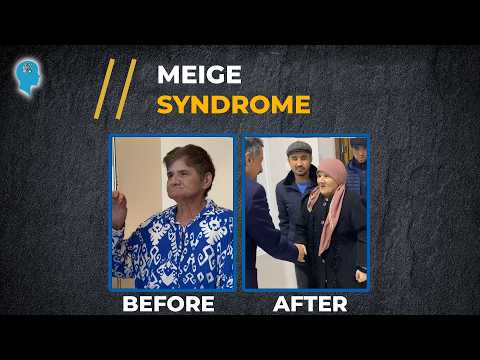
Our results. In our own case series, patients treated with DBS for cervical dystonia, Meige syndrome and myoclonus-dystonia have shown more than 90% improvement in their symptoms, based on clinical assessment and documented on video. Individual results vary.
Patient videos: Meige syndrome after DBS

Frequently asked questions
Is Meige syndrome the same as blepharospasm?
No. Blepharospasm affects only the eyelids. Meige syndrome is blepharospasm plus dystonia of the lower face, jaw or tongue.
Is Meige syndrome dangerous?
It is not life-threatening, but it can be very disabling. Severe blepharospasm can make a person functionally blind, and jaw dystonia can make eating and speaking hard.
Can DBS treat Meige syndrome?
Yes. In a randomized double-blind trial, both GPi and STN DBS improved movement scores by about 60% at 12 months.[1]
Which target is better for Meige syndrome, GPi or STN?
In the randomized trial the results were almost identical.[1] The target is chosen individually, taking into account other symptoms, the device and battery life, because STN stimulation used less electrical energy in that trial.
What is Brueghel syndrome?
Brueghel syndrome is another name for Meige syndrome, especially when jaw opening is prominent, after a painting by Pieter Brueghel that appears to show it.
Sources
- Globus pallidus internus versus subthalamic nucleus deep brain stimulation for Meige syndrome: a randomized controlled, double-blind, multicenter trial. J Neurosurg. Published online 2026. Source
- Simpson DM, Hallett M, Ashman EJ, et al. Practice guideline update summary: Botulinum neurotoxin for the treatment of blepharospasm, cervical dystonia, adult spasticity, and headache. Neurology. 2016;86(19):1818–1826. Source
- Pallidal versus subthalamic deep brain stimulation for Meige syndrome: a systematic review and meta-analysis. Heliyon. 2024 (March). Source